When it comes to selecting textbooks, politics is ‘impossible’ to keep out

This story was completed for my Advanced Reporting class and published on Arizona Sonora News

Recent high-profile cases of ideological fights concerning the material contained in textbooks at public schools highlight the role political preferences play in selecting texts, members of the education community say.

In Gilbert, the local school board voted late last month to edit material in a biology textbook after conservative members of the board determined it did not comply with state law on how abortion should be presented in schools. A controversy also occurred in Jefferson County, Colo. in September between conservative school board members and its teachers and students over the board’s proposal to amend the curriculum of an Advanced Placement U.S. History course.

These instances of ideological struggles in public school districts are hardly unique when it comes to selecting textbooks and curriculum, said Jory Brass, an assistant professor in the Mary Lou Fulton Teachers College at Arizona State University. The political preferences of those involved in the selection, as well as the school board approving it, always play a role, he said.

“In my view, it’s impossible to take politics out of education,” Brass said. “The question is what kind of politics should govern public education and how should the public be involved in decisions concerning public education.”

These political preferences just don’t often turn into ideological fights and manifest as national media stories, said Gustavo Fischman, a professor in the Mary Lou Fulton Teachers College at Arizona State University.

He said the selection of textbooks is always a political decision because whatever is chosen has ideological implications.

For Tucson Unified School District, the second largest school district in Arizona, written policy tries to keep ideological preferences at a minimum.

The TUSD governing board policy for selections and adoption of textbook and supplementary materials instructs those selecting the text to “place principle above personal opinion and reason above prejudice in the recommendation of resources.”

The TUSD Superintendent establishes textbook selection procedures that “shall provide for the appropriate involvement of staff members, students, and community members,” according to the policy. The recommendations for textbooks are then sent to the TUSD Governing Board for approval of purchase.

Adelita Grijalva, president of the TUSD Governing Board, said political preferences should never play any role in what textbooks are chosen. She said while the decision made in Gilbert is “tragic,” it didn’t surprise her due to the conservative leanings of the school board there.

“[Gilbert school board members] want to rewrite history and edit out parts they don’t like,” Grijalva said.

TUSD is no stranger to political controversy regarding curriculum.

In 2010, the Arizona legislature voted to ban TUSD’s Mexican-American studies program because legislators felt the program promoted racism and advocated for the overthrow of the government. The controversy made national headlines and led to protests.

The TUSD Governing Board has since voted to reinstate the program in compliance with a federal mandate to provide the material to students.

The Gilbert and Mexican-American studies program controversies have garnered national attention on Arizona’s education system, but Brass said the situation in the state is not unique and follows national trends on school governance policies.

Arizona, however, has several factors that make it easy for outside interests to help shape educational and curricular policies, Brass said. Both the decisions in Gilbert and Tucson had to do with laws passed by the state government.

“For the most part, these political processes bypass local school boards and local control,” Brass said.

Charter schools have a different set a rules when it comes to selecting textbooks and setting curriculum. These schools receive public funds but are able to operate independently.

Julia Toews, head of school at BASIS Tucson North, a charter school in Northeast Tucson, said teachers are responsible for choosing which textbooks they want to use for their classes. Some teachers even choose not to use a textbook and rely on their own knowledge to teach the material.

Toews said that on a deeper level politics plays a role in everything. In a subject like history, for example, students aren’t being taught to believe in the material, just what other people have believed, she said.

“I think you need to be sensitive to all the families you’re serving,” Toews said, “but … if you teach it correctly, you should never have a problem.”

Fischman also said textbook publishers have a role in perceived biases in the material taught to students. He said the publishers mostly cater to the curricular preferences of the larger states, like Texas and California, when they are producing the text.

Smaller school districts also suffer from limited options when selecting their books, he said.

“It’s a two-way route: what the school board decides and what the textbook companies offer,” Fischman said. “If there is no pushback from the educational community to make those textbooks better, they will not provide that.”

There isn’t a perfect model for textbook selection that keeps ideology out of the process, Fischman said. Even in Kansas where school boards are unelected positions, he said, members assert their political preferences when setting curriculum and selecting textbooks.

Fischman said he believes the most effective way to go about selecting textbooks is to involve teachers in the process as much as possible, but there is no real solution to keeping politics out of choosing what students are taught.

“Education is always a terrain of political fights,” he said.

View this story on Arizona Sonora News here
Independent gas stations continue to decline in Tucson

This story was completed for my Advanced Reporting class

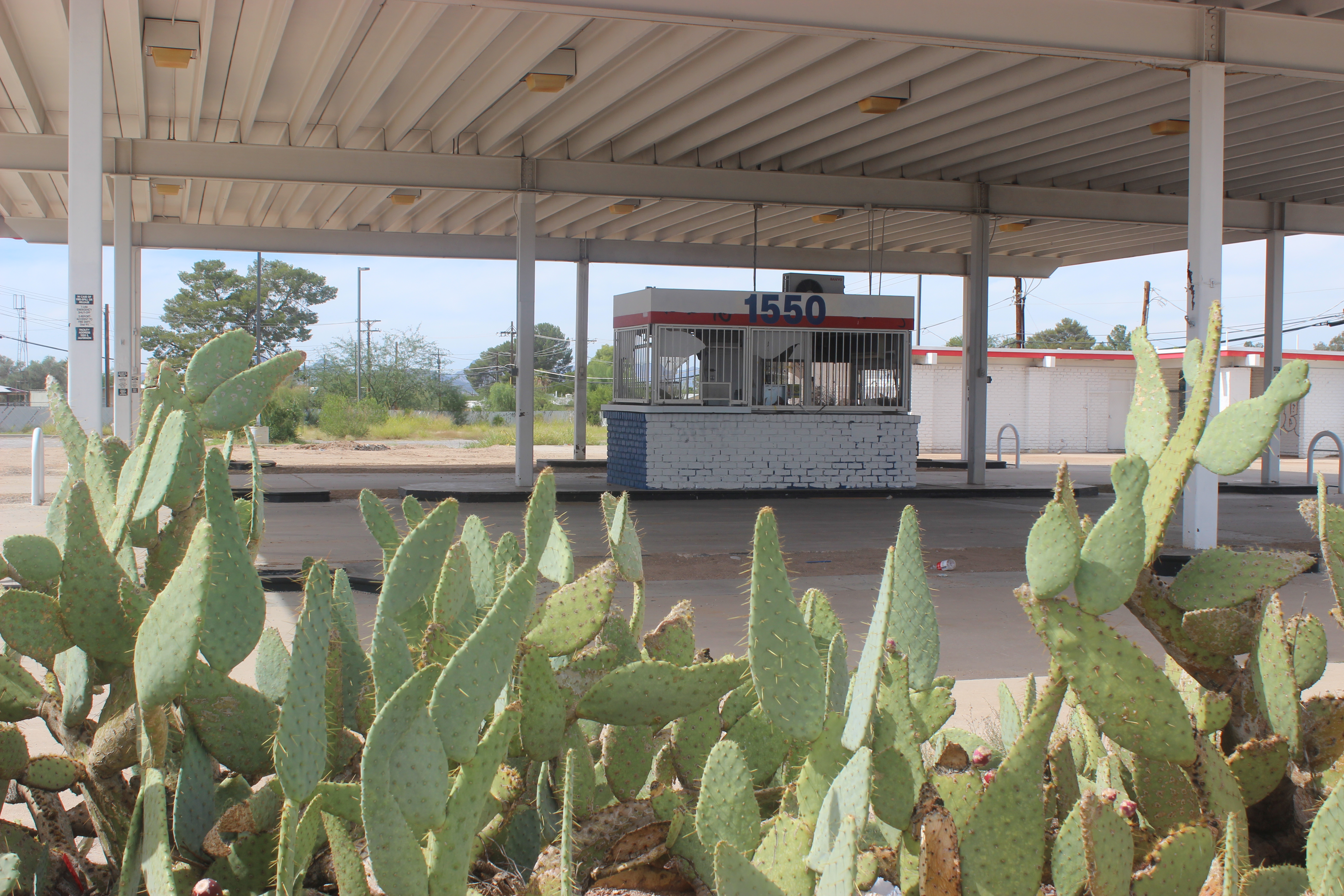
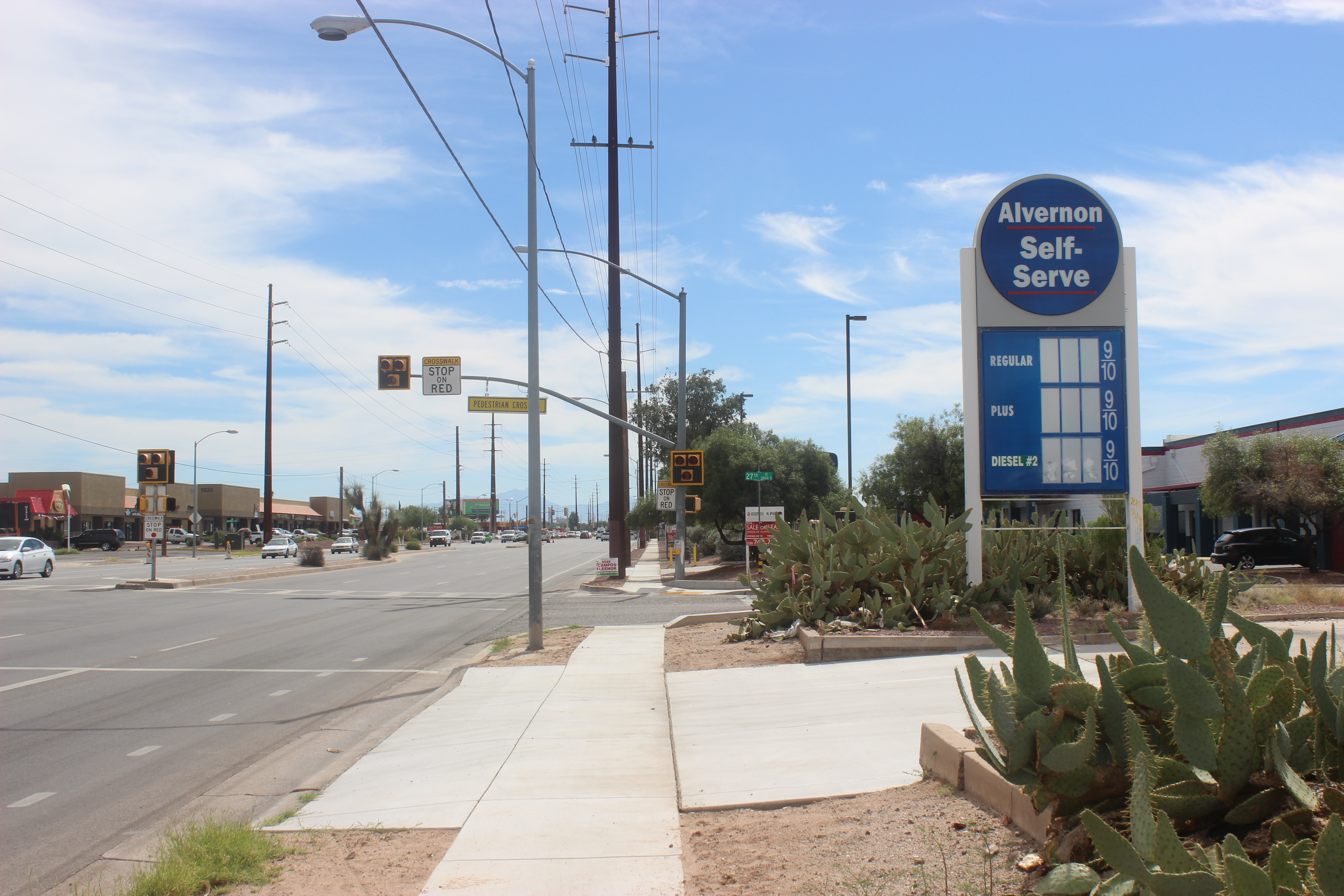
Only a few cacti protect the former Alvernon Self-Serve gas station on the corner of South Alvernon Way and East 27th Street because the chain-link fence was taken down some time ago.

The decaying sign with three fuel grade options out on the street still attempts to beckon potential customers driving down South Alvernon Way, while the former shop nestled between the gas pumps suffers from graffiti covered walls and a shattered window. It’s been like this for about four years. Just a few hundred feet down the road, a steady stream of cars pulls into and out of the modern, standard-type QuikTrip.

IMG_1293

This is a microcosm of what’s happening across Tucson and across the country. Larger service station chains are pushing smaller, independent franchises out of business, said Jerry Bustamante, senior vice president for public policy at the Arizona Small Business Association. Bustamante said the model developed by the larger chains, such as QuikTrip and Costco, is difficult for independent franchises to compete with.

“Their business model is, ‘We’re going to sell you among the cheapest gas town, we’re not going to make a ton of money on the gas, but we’re hoping that you’re going to come inside our convenience store and you’re going to buy coffee, soda, snacks or fresh deli,’” Bustamante said. “That’s where they make their money.”

In Tucson alone, there are 17 QuikTrips and 95 Circle Ks, according to their websites.

Ryan Egan, the realtor for the Alvernon Self-Serve property, said the independent service station couldn’t compete with the rise of the large chains like QuikTrip and Circle K and the owner sold Alvernon Self-Serve and three other gas stations spread across Tucson four years ago to Egan’s realty group.

For Egan, none of the properties have been easy to sell – especially the property on South Alvernon Way.

“Alvernon [Self-Serve] is out-positioned,” Egan said. “There’s a QuikTrip across the street and they’re always going to be able to sell gas for less than an operator at the Alvernon property.”

IMG_1294

The larger chains rely more on profits from sales inside the larger convenience stores they build and much less so on the gas that draws customers in the first place, said Ashley Langer, an assistant professor of economics at the University of Arizona.

These larger, regional chains are pushing independent gas stations out for other reasons as well, she said.

The total number of gas stations across the country is actually declining, Sanger said, in some part to due to rising fuel economy standards, which means drivers don’t have to fill up their gas tanks as often as they used to. This allows consumers to have more of a chance to shop around for lower-priced gasoline.

Sanger said the situation with rising gas station chains in unlike the rise of Walmart, because there are many more competitors among gas station chains. Companies like Circle K and QuikTrip are also just regional brands to the West.

“It’s just the free market reacting to a change in the situation and a change to what people need,” Sanger said.

Bustamante said ASBA advises its members to shop locally to keep more money in the community, but in the end it’s a free market and every customer gets to make their choice.

As more chain link fences rise up around former Tucson gas stations, the issue of what to do with the properties raises another issue.

Egan said he hopes he can sell the Alvernon Self-Serve property to be converted into another use.

Though, this is an expensive and time-consuming process, said Drew Sanderford, an assistant professor of real estate and planning at the UA.

In the course of time a gas station occupies a property, there will almost certainly be a leak from the station’s underground storage tanks, Sanderford said. The Environmental Protection Agency must be able to certify that the ground at the gas station is no longer contaminated for the property to be put in use again, which requires an underground clean-up process.

“This is an expensive proposition for just a regular person who wants to buy this land,” he said.

The EPA does offer some support for redevelopment of land that has been contaminated, such as gas stations.

Egan said it’s more of a psychological issue for potential buyers.

“[Gas stations] are perceived as being higher risk properties – and they are,” he said, “but if you have the proper expertise and contractor to perform the work for you, they can deliver you a property that can be certified as non-contaminated.”

Egan said that even if someone would want the property to be a gas station, the Alvernon location is too small to fit a convenience store to make it competitive against the larger chains.

The price of owning the property for four years now has been difficult, Egan said. It costs $200 to $500 a month to repaint the graffiti that regularly accumulates on the Alvernon Self-Serve property.

Currently no one is interested in buying the Alvernon Self-Serve, but Egan remains optimistic that another buyer will come along soon.

“There was someone interested in the Alvernon property about a month ago,” he said, “but the property wasn’t big for their concept so that fell through.”

Same-sex marriages begin in Arizona

Appeared in the Daily Wildcat on Oct. 17, 2014. Written with Meghan Fernandez, Daily Wildcat news editor.

Same-sex couples in Arizona can now marry following Attorney General Tom Horne’s decision today not to appeal a federal judge’s ruling that Arizona’s same-sex marriage ban is unconstitutional.

Horne said his decision to not appeal the ruling was based on legal considerations and not policy.

“I have decided not to appeal today’s decision, which would be an exercise in futility, and which would serve only the purpose of wasting taxpayers’ money,” Horne said in a statement. “I am issuing a letter today to the 15 county clerks of court with the directive that based on today’s decision by the federal District Court, they can issue licenses for same-sex marriages immediately.”

U.S. District Judge John Sedwick ruled this morning that the decision from the 9th U.S. Circuit Court of Appeals that same-sex marriage bans in Idaho and Nevada were unconstitutional applied to Arizona, invalidating the state’s ban on same-sex marriage

Sedwick said in his ruling that the bans had been ruled unconstitutional because “they deny same-sex couples the equal protection of the law.”

With the decision today, Arizona now becomes the 31st state to allow same-sex marriage in the U.S.

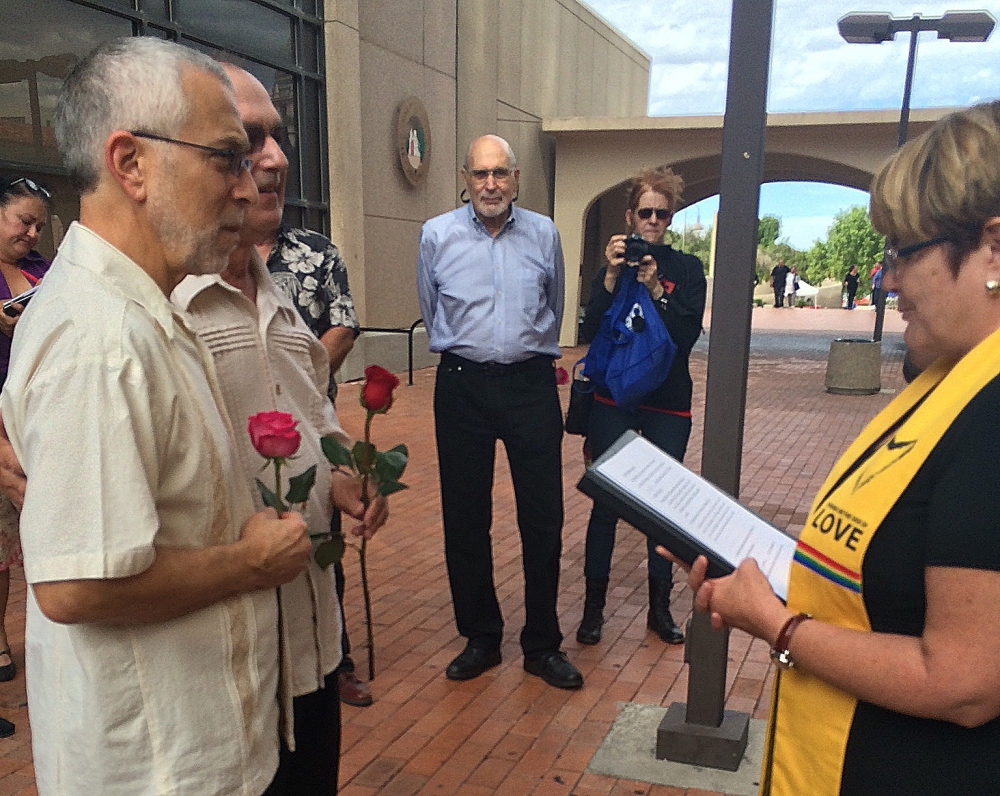
Same-sex couples rushed to the Arizona Superior Court in Pima County in downtown Tucson to sign their marriage licenses. Religious leaders from local churches were waiting outside the courthouse to perform marriage ceremonies.

21512_samesexmeghanfernanf

 The Rev. Owen Chandler, senior minister at Saguaro Christian Church, said even if couples don’t come to the religious leaders for a wedding ceremony, they will still be there in support.

“We’re just happy to be the backdrop of the celebration,” Chandler said.

Chandler said “it just seemed surreal” when he first heard about the decision to strike down Arizona’s ban on same-sex marriage.

“To see it is actually really part of the full momentum of marriage equality,” Chandler said.

Chandler, along with other ministers from different local churches, had been outside the courthouse since they first heard the news about the federal judge’s decision. He also said he was surprised that there weren’t groups of people opposing the decision at the courthouse.

Laura Tenenholtz, a deputy clerk at the Arizona Superior Court in Pima County, briefly took part in the celebration outside the court and said she has been with her partner for more than 11 years.

“It’s about f*cking time,” Tenenholtz said.

Nancy Franklin-Hicks and Davin Franklin-Hicks were one of the first couples to get to the courthouse and receive their marriage licenses. They had a commitment ceremony in 2002 but said they were following the news closely to find out when Arizona would rule the same-sex marriage ban as unconstitutional.

The two had not been able to marry prior to today because while Davin Franklin-Hicks identified as a transgender man, he was still recognized as a woman by the state.

Other Tucsonan same-sex couples included Chuck Gould and Michael Greenbaum. The two have been together for nearly 24 years and said they have been waiting for this day.

“I’m 76,” Greenbaum said. “I never thought I’d see the day.”

Greenbaum said one of the first things he plans to do as a married man is contact his accountant so he and Gould can file joint taxes.

Gould said he has lived in Tucson since 1967 and recalled the gay men he met back then who never thought this day would come and have passed away since.

“I always think about those guys who didn’t get married,” Gould said.

Robert Gordon and Stephen Kraynak had been together for 16 years before saying their vows today outside of the courthouse. Gordon and Kraynak met in Columbus, Ohio, at the Unitarian Universalist Church.

Gordon and Kraynak had a union ceremony at the church in Ohio in 2003, but it wasn’t state-recognized.

“So we’ve been waiting for this day for 10 years,” Gordon said.

Chris Sogge, a graduate assistant for LGBTQ Affairs at the UA, said the beginning of same-sex marriage in Arizona benefits faculty and students at the UA.

“Because as a state we’re recognizing marriage … that will end up bringing more acceptance of [lesbian, gay, bisexual, transgender and questioning] people and will then ripple through into the systems and into their own specific institution,” Sogge said.

Gov. Jan Brewer voiced her disapproval of the decision to strike down the state’s same-sex marriage ban. In a statement, she said the courts have “thwarted the will of the people.”

“It is not only disappointing, but also deeply troubling that unelected federal judges can dictate the law of individual states,” Brewer said.

Earlier this year, Brewer vetoed a religious freedom bill known as SB 1062 that critics derided as discriminatory against LGBTQ people.

The decision also comes on the last day of Coming Out Week at the UA, which brings visibility to resources available to the LGBTQ community at the university.

— Joey Fisher contributed reporting to this article.

View on dailywildcat.com here

Board of regents considering new tuition setting process for universities

Appeared in the Daily Wildcat on Sept. 25, 2014

FLAGSTAFF — The Arizona Board of Regents discussed changing the tuition setting process for the state universities at its meeting on the Northern Arizona University campus on Thursday.

The new process would break up the tuition setting into three separate meetings occurring at each of the universities — UA, NAU and Arizona State University — instead of setting all of the universities’ tuition rates at one meeting. The board of regents is also considering changes that would involve multi-year tuition plans and a new business cycle for Arizona universities’ governing board.

Eileen Klein, president of the board of regents, said the separate meetings would allow the regents to get to understand the operations and elements of each university, and they would set tuition rates at the same time as they do the operational and financial review for that university.

She said this would help the regents view each of the universities separately rather than just side-by-side. In the past, tuition rates for all three state universities have been set by the regents at a single meeting in April.

“We would be moving away from this annual tradition where we stop the presses and spend all of our time focusing on tuition and there’s no context to any of the discussion,” Klein said.

This would also mean a move away from the annual tuition hearings that occur on each campus of the state universities, she said. Klein added that the student regents would work with student governments to get more input.

Regent Greg Patterson said the system now where the regents vote on all the tuition increases at the same time is difficult, and that he supports the proposal for changing the tuition setting process.

“I like the deep drill that says, ‘We’re on this campus to discuss your plan and we’re going to hear your tuition plan and how it fits in,’” Patterson said.

Student Regent Valerie Hanna said when she discussed it with students, there was anticipation for rethinking how tuition and fees are set.

“A lot of students are really excited that [the new process] will bring a lot more predictability,” Hanna said.

This would mean a change to the calendar of the board of regents’ business cycle, Klein said. The tentative schedule for 2015 as Klein has it in the proposal has the tuition setting for the UA in February, NAU in March and ASU in April.

Regent LuAnn Leonard said she is worried that February would be too soon for the UA to provide the numbers that would be needed to decide on tuition rates for the university. Hanna also voiced concerns over the UA having only a few months to come up with its tuition proposal.

The proposed multi-year tuition setting process would have the regents set tuition rates for the universities for several years out. Klein said this would give some certainty to the university presidents of the revenue they can expect over several years.

Student Safety

The regents also discussed student safety at the state universities. Last year, the board of regents set up the Statewide Student Safety Task Force last year to address these concerns. Local task forces for each university submitted their findings at a meeting in June.

“There was some initial concern, I think, on everyone’s part about what the objective was, but the universities did a terrific job of making it a very inclusive process,” Klein said.

The reports from each of the task forces can be viewed on the board of regents’ website.

Klein said one of the main takeaways from the task force was better working with local law enforcement agencies and local governments on student safety.

Klein added that they want to think about prevention and not only enforcement when it comes to ensuring student safety.

Leonard said the discussion on student safety among the state universities will be ongoing.

Items approved

The board of regents also voted to approve several projects, budget requests and other items requested by the universities including:

-The operating budget requests for the state universities for the 2016 fiscal year

-Capital improvement plans for the universities for 2016-18

-Funding proposed projects for the state universities from the board of regents’ innovation fund

-A ground lease for the UA with the city of Phoenix to build onto its Phoenix Biomedical campus with the Biosciences Partnership Building

-An agreement for the UA on the operation of the Giant Magellan Telescope

-The UA’s Bioscience Research Laboratories project

-The UA’s request to enter into an agreement with Pima County and the YMCA to build a library complex at the UA Science and Technology Park

-An addendum to the UA’s academic strategic plan that would add a doctor of veterinary medicine degree. Jay Heiler, vice chairman of the board of regents, voted against the proposal, making it the only item to receive a dissenting vote.

The board of regents moved quickly through the items to approve during the afternoon, raising concerns from one of its members.

Regent Rick Myers said he was “uncomfortable” with the pace the regents were moving at and that he felt the vice presidents for research from the three universities were “shortchanged” when they were rushed through their presentations.

Patterson responded to Myers’ concerns, saying the regents worked on each of the items for a long time in committees and the meeting was pressed for time for several reasons.

The regents will reconvene at NAU on Friday where they will vote on approving performance incentives for UA President Ann Weaver Hart, as well as ASU President Michael Crow.

View on dailywildcat.com here

Police conduct questioned after Saturday night’s clash

Appeared in the Daily Wildcat on April 1, 2014

The Tucson Police Department is internally investigating allegations of police misconduct from Saturday night’s clash on University Boulevard following the Arizona men’s basketball team’s loss in the Elite Eight.

One cell phone video shows what appears to be a Tucson Police Department officer knocking a woman over a bench as she walks behind the line of riot police stretched across the street. People around the woman who was knocked over begin yelling at the officer and one shouts, “What did you do that for?”

A version of the video posted to Facebook by Cara Monier, an undeclared UA freshman, had been shared more than 3,000 times as of Monday evening. Monier said she received the video from a friend and shared it to make sure others could see what happened.

“As soon as I saw [the video] it made my blood boil,” Monier said. “I am so intensely angry at the way that police officers were treating people and the way they were handling the situation.”

police

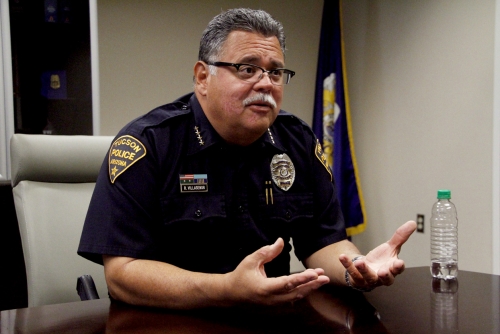
The incident is currently being internally investigated by TPD, according to Roberto Villaseñor, TPD chief of police. The officer in question has already been interviewed regarding the incident.

“We’re going to look at all the circumstances and make our determination there,” Villaseñor said, “but we’re going to do it based off of everything, not just one video clip everyone’s looking at.”

The officer was wearing a camera at the time of the incident and Villaseñor said police would be looking through what the camera recorded as they conduct their investigation.

 Villaseñor also said at the point in Saturday night’s events that the incident occurred, the area had been closed off as police had declared an unlawful assembly.

“Once we’ve closed off an area, you can’t go through our line,” he said.

Villaseñor said TPD would be reviewing all aspects of the incident and asked for patience from the public.

“They want quick action based on the video,” he said. “It doesn’t work that way. We need to do a thorough investigation.”

Another video shows a man, identified as Alexander Davidson, 23, walking toward the line of riot police with arms outstretched. Police shoot him multiple times with pepper balls. The man is then restrained by several officers and pulled back behind the line of officers. One officer appears to strike the man in the face as he is being grabbed.

At that point, members of the crowd begin chanting, “Police brutality.”

Davidson did not respond to requests for comment. He was one of 15 people who were arrested Saturday night.

After an unlawful assembly has been declared, when people refuse to follow orders issued by police, police will fire pepper balls at their feet first, according to Villaseñor. If the individual still doesn’t fall back, officers will begin shooting pepper balls at the person.

“He got hit several times in the chest and that still didn’t stop him, so at that point the only option is to go out and grab him and take him into custody,” Villaseñor said.

TPD received three complaints regarding officers’ actions Saturday night, one being about the woman who appeared to be knocked over a bench by an officer. Villaseñor said TPD spent three to four hours Monday morning going over the events that transpired.

Some are questioning TPD’s preparations in having officers in their protective equipment while the game was still being played, according to Villaseñor. About 60 to 70 officers were present on University Boulevard during the game.

Monier said she was watching the game at Gentle Ben’s Brewing Co. and saw a strong police presence on University Boulevard before the game ended. She said the attire worn by police indicated they were expecting fans to grow unruly after the game.

“The Tucson police officers set the atmosphere for the riot to happen,” Monier said.

Police were wearing protective helmets and face shields and were carrying gas masks to prepare for anything that could happen, Villaseñor said.

Overall, he said he believed officers responded well given the situation they faced.

“I think my officers acted professionally,” Villaseñor said. “Does that mean that everything single thing we did was right? I’m not going to make that statement.”

In a statement from Kendal Washington White, assistant vice president for Student Affairs and dean of students, she said TPD’s response was necessary.

“The Tucson Police Department took the actions necessary to ensure public order, safeguard property and protect people,” White said.

TPD will share the results of its reviews of the events of Saturday night with the UA, according to White’s statement.

View on dailywildcat.com here

Study Buddies: Adderall at the UA

Appeared in the Daily Wildcat on March 25, 2014

Jack*, a UA physics sophomore, knocked on a door, which was opened to reveal a cramped and dimly lit dorm room. Michael*, a fine arts freshman, led him through his room, movie posters filling the walls and bottles of alcohol scattered throughout. Michael opened a desk drawer and produced a prescription bottle filled with orange capsules.

“I just need two,” Jack said. He had a midterm coming up and said he needed something extra to help him study.

Michael then placed two capsules into a Ziploc bag and handed it to Jack. On the capsules, in black script, was written: ADDERALL XR 20 mg.

Michael has a prescription for Adderall to treat his Attention Deficit Hyperactivity Disorder, and he sells extra pills on the side at $5 each.

adderall

Michael has cycled through some 20 different ADHD medications by doctors since he was diagnosed with the disorder at the age of 7. About a year and a half ago, his doctor prescribed him Adderall for the first time. Adderall is an amphetamine commonly prescribed to ADHD patients to help improve their concentration.

Some students use Adderall without a prescription as a way to boost their academic performance, especially when they feel they’re falling behind, said Lynn Reyes, an alcohol and other drug prevention specialist with Campus Health Service.

“They’re in trouble; finals are coming up,” Reyes said. “So they think, ‘I’ve got to pull an all-nighter. I’m going to try some Adderall.’”

Adderall use is not an uncommon part of the college experience, with 31 percent of four-year students reporting having taken the drug without a prescription at some point, according to a 2012 study in the Journal of American College Health.
In the annual Health and Wellness Survey conducted by Campus Health in 2013, 6.6 percent of UA students admitted to using Adderall or similar ADHD medications without a prescription in the past 30 days, and 13 percent said that they had used it the past year.

The only substances with higher abuse rates among UA students are alcohol and marijuana, Reyes said.

Unlike alcohol and marijuana, recreational use of Adderall is not nearly as common. The study in JACH showed that about 75 percent or more of college students who use Adderall use it to help them academically.

Adderall is a stimulant, not unlike coffee, said Keith Boesen, director of the Arizona Poison and Drug Information Center.

“We use caffeine to wake ourselves up and help us concentrate,” Boesen said. “Adderall takes that to the next level.”

Prescribing a stimulant to those with ADHD may seem like a puzzling choice, but the stimulation from Adderall actually has a calming effect on people with ADHD.

“It helps people working with those parts of the brain to focus and be able to pay attention, particularly in school, where we find a lot of the early diagnoses [of ADHD],” Reyes said.

This makes the drug appealing to college students looking for something to help them concentrate or stay awake.

Obtaining Adderall through Campus Health is not easy, Reyes said. While Campus Health will continue to prescribe ADHD medications to students who have a prescription from a family doctor, it will never begin prescriptions for students who simply walk in and say they have ADHD.

“Campus Health does not start people on ADHD meds because we don’t have the staff to assess that particular disorder,” Reyes said. “So, what we do when someone feels that they need that, we give them referrals … so that they get assessments.”

Some students turn to friends, or friends of friends, to get them Adderall instead.

Michael’s doctor warned him before he went off to the UA to keep his Adderall safe, saying others would come asking for it.

A few months ago, in his first semester at the UA, Michael’s friends learned of his Adderall prescription, and asked if he would consider selling it. He went online and researched the price of Adderall and discovered that he could make some extra money off of his prescription.

“I thought, ‘I have surplus, so why don’t I profit from it?’” Michael said.

He receives a package from home once a month containing his prescription, which consists of 30 pills, one for each day of the month.

The pills he doesn’t take, he sells — to friends, acquaintances and even strangers.

“For me, it’s not like I need it every day to function. Some people need it to function,” he said.

He doesn’t take his daily pill on the weekends when he drinks because the two don’t mix well, and on some days he wakes up and doesn’t feel he needs to take it. Slowly, a surplus accumulates, and he has enough to begin selling.

After he started selling to his friends, they began referring others to him. He estimates that during finals week last semester he made about $250 from selling his Adderall.

Michael said that he knows what he is doing is illegal. Adderall is classified by the Food and Drug Administration as a Schedule II controlled substance, which indicates it carries a high risk for abuse, and places it in the same category as cocaine and methamphetamine.

The UA Student Code of Conduct prohibits the unauthorized use, sale, possession or distribution of any controlled substance.

Under Arizona state law, Adderall as an amphetamine is considered a dangerous drug, and possessing a dangerous drug is a Class 4 felony. The sale or transfer of a dangerous drug is a Class 2 felony.

That section of the Code of Conduct covers many different drug offenses, said Kendal Washington White, dean of students and assistant vice president for Student Affairs.

The Dean of Students Office does not track each drug case it handles with the specificity necessary to determine how many cases have involved Adderall, according to White, but about 95 percent or more of those cases involve marijuana usage.

Most drug cases handled by the University of Arizona Police Department also involve marijuana usage, according to Brian Seastone, UAPD chief of police.

Michael said that he takes steps to avoid getting caught. He doesn’t give out his name to strangers who are referred to him, and he trusts his friends to not give away his name.

Amanda*, a film and television freshman, is one of those friends.

Amanda first tried Adderall last semester when finals week came around, taking three pills during the week to aid her studying. Now, she takes it every time she has to study for a major test or when she has a paper due.

“I have a really, really hard time focusing on my work, just in general,” she said, “so when I need to actually focus, I take it.”

Amanda said that she feels the Adderall does help her perform better academically.

“I definitely would not have been as prepared for my exams [without Adderall],” she said. “I can guarantee that.”

Despite the idea that Adderall helps students perform better, the study in JACH also suggests that nonmedical use of Adderall is associated with poorer academic performance.

When doctors prescribe Adderall, it’s done with caution and fine-tuning to put the patient on the proper dosage, Boesen said. When students get their Adderall from someone with a prescription, they often don’t know how much they’re supposed to take or they add other stimulants to it, such as energy drinks or coffee.

“It’s an incredible amount of stress on the body,” Boesen said. “It’s this chemical stress that keeps our body in fast forward and puts a great deal of stress on the heart.”

That stress can lead to overheating, seizures and even heart attacks, Boesen said.

“There’s this perception that if it’s a prescription medication, it must be safe,” Boesen said. “And it’s not. It’s only safe if it’s taken appropriately.”

Reyes said that the most common problems she sees with the misuse of Adderall are the negative short-term effects it has on students. The negative effects are similar to that of drinking too much coffee, Reyes said.

“You’re being overstimulated so you think, ‘That will really keep me awake,’” Reyes said, “but overstimulation just makes people feel sick.”

Amanda said that she hasn’t felt any major side effects from using Adderall, other than a bad headache.

“A headache is kind of worth being able to get everything done,” she said.
Like any drug, Adderall also carries the risk of dependency, Reyes said, but it’s not something she sees often.

“The students that I see here just want a quick fix,” Reyes said.

Amanda said that one of her friends has grown concerned about her Adderall use, but she doesn’t feel dependent on it, and she plans to keep taking it as she needs it.

Michael also finds no problem embracing the Adderall culture. The opportunity to make some extra money is all the incentive he needs. Recently, he’s started selling edible marijuana as well.

Michael said that when he arrived at the UA last August, he had no idea he would be in the position he’s in now. Although sometimes he feels guilty about selling Adderall, he isn’t planning on changing his lifestyle any time soon.

“I don’t think I feel guilty enough yet to stop,” he said.

— Editor’s note: * denotes a name that has been changed due to the sensitive nature of this article.

— Jazmine Foster-Hall contributed reporting to this article.

View on dailywildcat.com here

Lecture results in hate mail, threats

Appeared in the Daily Wildcat on Nov. 7, 2013

A UA professor received hate mail and emails after videos of his lecture regarding Republicans and Fox News viewers surfaced on the Internet.

The videos showed Pat Willerton, an associate professor in the School of Government and Public Policy, during a lecture on Oct. 8 in his class, “Politics, Policy and Governance: The U.S. and the World.” Some of those who have seen the videos accuse Willerton of denigrating both Republicans and Fox News viewers and creating a hostile environment in the classroom.

Willerton said he has received a fair amount of hate mail and email regarding the videos. One particular email he received was troubling, he added.

“The last full paragraph said something to the effect … that I’ll end up with a bullet in the back of my head,” Willerton said. “Well, that’s a hell of a thing to read.”

professor


The slides shown during Willerton’s recorded lecture cite a study from Fairleigh Dickinson University examining people’s knowledge of current events and the news sources they rely on, showing that both Fox News and MSNBC viewers scored low in the survey.

“Fox News does come in last,” Willerton said, “but MSNBC is pretty damn close.”

Willerton said another concern raised was that he appeared to single out Republicans on the issue of gerrymandering in one video. Willerton said the slides from the lecture provided current examples of gerrymandering by Democrats in Illinois and Maryland, in addition to Republican examples in Ohio and Pennsylvania.

 Chris Sigurdson, senior communications adviser for the UA, said that the university defends Willerton’s right to follow his own approach in conducting the class.

“To all indications, he’s conducting the class responsibly, with a multitude of viewpoints and within his authority and expertise,” Sigurdson said. “As the professor, he has the academic freedom to teach the class within his expertise.”

Willerton disagreed with the claim that his lectures create a hostile environment, and said that the videos shot during class were taken out of context.

“Of course it was [taken out of context],” Willerton said. “That was just cherry-picking.”

Willerton also disagreed with the claim that his style of teaching and his viewpoints intimidate those who would dissent in the classroom, adding that he sees little evidence students have any fear of him.

“People will ask me tough questions,” Willerton said, “and if someone really doesn’t want to do that, then they can tweet me [during class]. It’s completely anonymous.”

Paxton Endres, a political science sophomore and a student in the class, said he agrees that Willerton’s teaching doesn’t create a hostile environment.

“What I love about Dr. Willerton is that he welcomes feedback and responses,” Endres said. “In fact, he encourages it, and when he is wrong, or if a student makes a valid argument, then he admits to it.”

Professors should also be able to express their own opinions, especially in classes about politics where students must learn to defend or argue certain sets of beliefs, Endres said.

Michael Schaller, a Regents’ Professor of history,said that professors shouldn’t be barred from expressing their personal political opinions because of their profession.

“We don’t put on blinders when we become professors,” Schaller said. “I don’t think you should use your classroom to promote a partisan political agenda, but I think it is perfectly valid to point out — in a class on history or politics — the implications of something. … If I do have a political barb, I make sure it is separate from the lecture.”

The only time professors’ politics should not be a factor is when it comes to grading, according to Endres.

Willerton has told the class that his personal opinions play no factor in grading and that his eight teaching assistants do his grading.

Willerton said he does bring provocative issues into the classroom and expects differing opinions on what he presents.

“There are over 1,060 kids in both my lectures,” Willerton said. “Someone is going to be troubled by something I say.”

View on dailywildcat.com here

Rising tensions in Ukraine hit home

Appeared in the Daily Wildcat on March 5, 2014

Sergii Gorbachov is worried.

The second year master’s student studying Russian is thinking of his family back home in Ukraine now, as he watches his country falling apart on the news.

The Eastern European country of 45 million is in crisis. In the past two weeks, Ukraine has seen a revolution and an invasion. Late last week Russian military units covertly and swiftly seized control of Crimea, a peninsula in southern Ukraine.

War seems a grim prospect to Gorbachov. His hometown of Kharkiv, Ukraine, is only 20 miles from the Russian border. What’s even more disconcerting to him is what could happen to his 26-year-old brother, a member of the Ukrainian army reserves.

ukraine

“He will be called to go to war,” Gorbachov said. “If something happens, he could die.”

Unease hangs over the whole of Ukraine as well, as neither side seems ready to back down, according to Pat Willerton, an associate professor of political science. Both Ukraine and Russia believe time is on their side.

“I’m pretty confident that the Russians are not leaving,” Willerton said. “They will not leave if they feel that their interests and those of Russians and Russian-oriented Ukrainians are not being respected.”

 Protests had been going on for months in Ukraine’s capital Kiev over Ukrainian President Viktor Yanukovych’s decision to not seek closer ties with the European Union, but they became increasingly violent after the government enacted laws cracking down on protesters’ rights.

Two weeks ago, Yanukovych was ousted from power following bloody protests in Kiev that resulted in dozens of deaths.

Gorbachov was not upset to see the government go.

“I didn’t like the government because everything is corrupt — education, health care, police,” Gorbachov said. “That’s why I came here.”

Willerton said the ousting of Yanukovych and the quick ascension of a new nationalist-oriented government in Kiev has led Russia to take actions to protect ethnic Russians and Russian citizens in Ukraine.

The violence since the overthrow of Yanukovych hasn’t been as one-sided as the Russians claim, according to Anna Vozna, a first-year master’s student studying Russian, who originates from Kharkiv. The images of pro-Ukrainian protesters in her hometown being dragged through the streets and forced to their knees in the middle of the square are deeply troubling to her.

“It’s Ukrainians who have problems there, not Russians,” Vozna said.

Mikhail Beznosov, a limited-term adjunct instructor in political science, is currently in Kharkiv as tensions simmer. He said in an email that the situation in the city is “quite tense.”

Beznosov waited for the arrival of pro-Ukrainian protesters following Yanukovych’s ousting — and they came. They took control of the regional administration building in the city and attempted to destroy a statue of Vladimir Lenin in the central square.

Beznosov said most people in southern and eastern Ukraine, areas seen as pro-Russian, are not happy with the new government in Kiev. They still view Yanukovych as the legitimate president of Ukraine, and see the protesters as nationalists with a “neo-Nazi essence.”

Beznosov also leads the Arizona in Yalta study abroad summer program for the political science department, a program that is now in limbo given the current crisis in Crimea. Yalta lies on the southern coast of the Crimean peninsula.

The UA Study Abroad and Student Exchange Office has decided that hosting the program in Yalta is no longer feasible given the security situation in the area, but Beznosov said he is looking at other options for students who applied for the program. He said he offered the countries of Bulgaria,
Georgia and Montenegro as alternatives.

The problem in Crimea is not simply a present-day conflict, said Teresa Polowy, head of the Department of Russian and Slavic Studies. Polowy’s ties to the area lay in that his grandparents are from western Ukraine.

“This is a 21st century iteration of a situation that has existed in Ukraine for 500 years or more,” Polowy said.

Polowy said Ukraine has long been torn between whether it should be closer to the West and Europe or toward the East and Russia. Crimea has a long history that must be understood as well, Polowy added.

Nikita Khrushchev handed Crimea over to Ukraine from Russia in 1954 when the two were still republics within the greater Soviet Union. Crimea is home to a large population of ethnic Russians, and Russian is the predominant language spoken there. Strategically, Crimea is home to a Russian naval base in the city of Sevastopol.

“It’s about Putin really reclaiming those strategic areas for Russia,” Polowy said. “Crimea was attached to Ukraine artificially.”

Gorbachov said he is uncertain of what comes next for Ukraine. A week ago, he never would have guessed that Russia would invade Crimea.

Vozna said she thinks the situation will improve now that Western nations are taking measures to punish Russia for its action, and that it will send a message to Putin.

“Maybe people will understand that if we allow him to take Ukraine now, it may spread all over Europe, because he is dangerous,” Vozna said.

Willerton said it is highly unlikely that the U.S. or the West will intervene militarily because Ukraine is not a vital interest — not to mention the U.S. is war-weary as it is.

Ukrainians and Russians don’t want to fight each other, Willerton said, but he emphasized that the crisis is not likely to end any time soon.

“It’s going to be hard to please everybody,” Willerton said. “Everyone seems to agree that they don’t want to break the country up, but I don’t know where it goes from here. I don’t know how you please Russians in the East and Crimea and Ukrainians in the West.”

Vozna planned on staying at the UA after she gets her master’s, but now she’s not so sure.

“Now, when I see all [these] events going on in my country,” Vozna said, “I think that I want to come back.”

View on dailywildcat.com here

GOP ad hits DuVal over tuition increases

Appeared in the Daily Wildcat on Sept. 4, 2014

A recent ad funded by a Republican group targeted Democratic gubernatorial nominee Fred DuVal for voting to approve tuition hikes when he served on the Arizona Board of Regents.

The 30-second TV ad from the Republican Governors Association hit DuVal for voting for the tuition hikes that caused the cost of tuition and fees at the state universities to rise by 99 percent while he served on the board.

A fact check from the Arizona Republic rated the claim in the ad as true, giving it four stars. DuVal voted to raise tuition each year and it doubled over the course of his six years as a member of the board of regents, the Republic said.

The board of regents sets the rates for tuition and fees at the UA, Arizona State University and Northern Arizona University. DuVal served on the board from 2006 to 2012, and during that time, in-state undergraduate tuition at the UA increased from $4,600 to $9,100.

The DuVal campaign, however, contends that the increases were necessary due to cuts in funding to the state universities from the Legislature.

“Governor [Jan] Brewer and the Arizona Legislature cut higher education by more than $400 million during the recession, more than any other state in the country,” said Geoff Vetter, a spokesperson for the DuVal campaign. “Fred [DuVal] kept the doors of our universities open.”

Mark Killian, the current chair of the board of regents, said the ad is misleading and lacks context on why tuition had to be raised.

“What the ad leaves out is the Republican-controlled legislature cut the universities by nearly half a billion dollars while at the same time saying, ‘we want you to educate more students, we want you to give quality education,’ and left us holding an empty bag,” he said.

The regents and the universities worked to save on costs and keep campuses open, but raising tuition was necessary, Killian said. He added that the state’s universities’ per student contribution is now as low as it was in 1955, and he believes the state legislature is violating the Arizona Constitution where it says education must be as free as possible.

Vetter said DuVal worked to increase access and affordability to higher education while he served on the board. DuVal has also promised to veto any bill that continues to make cuts to education, Vetter said.

Killian also said he didn’t like the way the board of regents was portrayed in the ad.

“It makes it sound like the regents are greedy and we’ve raised tuition to persecute middle-income families, which couldn’t be further from the truth,” Killian said.

The ad opens with a mother lying awake in bed and the narrator speaks about how the sharp rise in college tuition in Arizona has forced middle-class families to pay more. The ad says DuVal voted to raise tuition each year and repeats that the increases were “just not fair.”

In a statement, Gail Gitcho, RGA communications director, said that DuVal did little to prevent the tuition increase that occurred while he served on the board of regents. This is the group’s first ad in the Arizona gubernatorial race.

“College students in Arizona can thank Democrat Fred DuVal for their ever-increasing tuition rates,” Gitcho said.

Killian, who describes himself as a conservative Republican, said he did not appreciate the RGA creating a campaign issue with the ad.

“I really don’t like outside groups coming into Arizona, defining the candidates and defining the issues for Arizona,” he said.

A recent poll of likely voters from Rasmussen Reports showed DuVal tied with his Republican challenger, Doug Ducey, at 40 percent with about two months to go until the general election.

View on dailywildcat.com here