From the campaign trail: Ducey swings through southern Arizona

As Doug Ducey prepares to be sworn in as governor of Arizona on Monday, I am posting a story I wrote for the Arizona Summer Wildcat covering one of his campaign events on the outskirts of Tucson on Aug. 5, 2014. Ducey was making stops through southern Arizona that day in the run up to the Republican primary election to stump on immigration and border issues. 

I got a brief interview with the then-state treasurer after the event and asked him about higher education issues and his decision not to attend a recent debate in Tucson, which his GOP opponents made a fuss of.
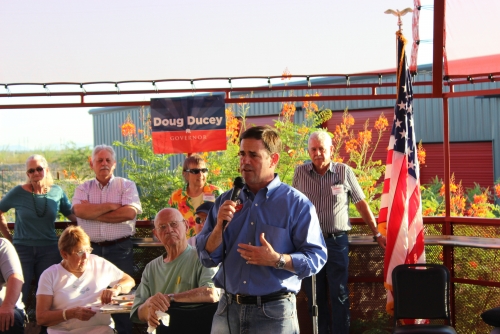
Doug Ducey

Republican gubernatorial candidate Doug Ducey toured through southern Arizona on Tuesday as the campaign for the Republican nomination for Arizona governor enters its final weeks.

The Ducey campaign made stops in Nogales to meet with law enforcement officials in the Arizona-Mexico border area and in Tucson at Hotrods Old Vail, where the Arizona state treasurer was joined by State Sen. Al Melvin, R-Tucson, and former Republican State Sen. Frank Antenori for a meet-and-greet with voters.

Melvin said he supported Ducey’s conservative credentials in the race for governor. Melvin was previously in the running for the Republican nomination for governor before dropping out and endorsing Ducey.

“I believe he’s got the leadership, the vision and the integrity to keep our state red and keep it as far away from blue or purple as we can make it,” Melvin said.

Ducey spoke with those in attendance and responded to their questions on topics from immigration to the Affordable Care Act to lay out his positions. He also spoke of his qualifications with his history of work in the private sector and building up Cold Stone Creamery.

“I built a company, now I want to shrink a government and grow an economy,” he said.

Ducey said he wants to get rid of unnecessary taxes and regulations and to ultimately eliminate the state income tax.

He also focused on immigration and border issues and said President Barack Obama has failed Arizona in his duty to protect the southern border, calling it a national security issue as well as a criminal one.

“I believe it’s the first job of our federal government to protect its citizens,” Ducey said.

“Our Tucson sector is wide open and unprotected.”

Ducey touted his recent endorsement from Maricopa County Sheriff Joe Arpaio,who is known for his tough stance on illegal immigration. He has also been endorsed by Texas Republican Sen. Ted Cruz and Wisconsin Gov. Scott Walker.

Ducey also addressed concerns over rising tuition costs at the state’s public universities. He praised the three state universities – the UA, Arizona State University and Northern Arizona University – but added that Arizona has less choice than other states when it comes to higher education.

“I want to make sure we get these costs under control so these kids have some idea what their budget will be for four or five years as they get their education,” he said. “I think there’s a way we can do that from state government to lock in those costs.”

Ducey later responded to criticism he has received on the campaign trail in recent days regarding the sale of Cold Stone Creamery and his failure to appear at a candidate forum at Pima Community College – West Campus on July 30.

Ducey said he had a conflict and could not attend the debate. He added that he has been in Pima County more than any other candidate during the campaign with an average of twice a month.

Scott Smith, mayor of Mesa and a Republican gubernatorial opponent, called out Ducey at the July 30 debate for not answering questions over Cold Stone Creamery and not appearing with the other candidates.

Antenori said Ducey’s opponents were trying to spread rumors about the candidate and said they were trying to buy the governor’s seat.

“They want to buy a governor,” he said. “They want to own the ninth floor [of the Arizona Capitol building] and the last thing you want is to allow one of those folks to get into the ninth floor.”

Ducey is running close in the polls with former GoDaddy executive Christine Jones in a crowded Republican primary field. The primary election is set for Aug. 26 and early voting is underway to see who will face likely Democratic nominee Fred DuVal.

View this story on dailywildcat.com here

Gallery: Yosemite in December – and in drought

I recently visited Yosemite National Park with my family in late December. I took some pictures as we toured the usual sights in the valley, and I also saw the drought plaguing California has not spared Yosemite its effects. There was a surprising lack of snow in the area and the park’s famous waterfalls trickle with much less volume and power than before.

Budget deficit looms over coming legislative session

This story is the first I completed as a part of the Bolles Fellowship with the University of Arizona School of Journalism. For the fellowship, I will spend the next semester in Phoenix covering the state Legislature for Arizona Sonora News. This story appeared on the news service on Dec. 22, 2014, and it was published in the Nogales International and the Eastern Arizona Courier.

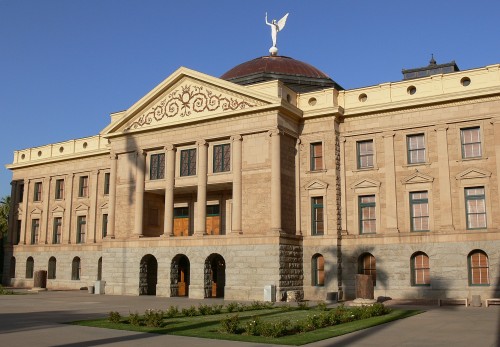
AZ_State_Capitol_Building_80629-500x347

As a new legislature and a new governor prepare to settle into Phoenix, a projected budget shortfall is not far from anyone’s minds.

Just a year ago, the outgoing governor boasted about Arizona’s “comeback” and now the state faces a grim budget situation as it heads into the next year. Revised projections show Gov.-elect Doug Ducey and the legislature will contend with a $520 million budget deficit this year and a $1 billion deficit for the next.

Now, many worry what impact any budget-balancing measures – raising taxes and cutting spending – will have on the state.

The downward projections come from the Joint Legislative Budget Committee and cite a sluggish economic recovery, less-than-expected revenues and a court order to fund K-12 schools as reasons for the state’s slide from surplus into deficit.

State leaders are now working to find ways to balance the balance but are short on specifics.

Ducey formed a budget study committee comprising people from the public and private sector to advise on how best to balance the budget, said Daniel Scarpinato, a spokesman for Ducey’s transition team.

Ducey is constitutionally required to submit a budget by Jan. 16, where it will begin to wind through committees and votes in a coming budget fight.

Scarpinato said Ducey has made it clear that he will not be raising taxes, though wouldn’t specify what programs would be cut to balance the budget as the study committee is still working on its plan.

Senate President Andy Biggs, R-Gilbert, however, said that he would keep raising taxes as an option for closing the budget shortfall.

“Everything is on the table,” Biggs said. “I’m a big believer that if you have everything on the table, you can have a nice discussion.”

Biggs said in the end, he believes, legislators will come to the conclusion that raising taxes would not be a wise option in the current economic conditions.

He also cautioned that these projections could still change and the economy could pick up steam soon as unexpectedly as it slowed down in the past year.

Though, the promises from Ducey not to raise taxes have some worried about what programs will be cut further.

The biggest piece of the budget is K-12 education, which accounts for more than 40 percent of the state’s expenditures, followed by Medicaid and prisons.

Further adding to the budget woes, a Maricopa County Superior Court judge ordered the state to pay K-12 schools $336 million they were owed because Arizona failed to properly adjust funding for inflation during recent years in accordance with a voter-approved law. That $336 million is included in the adjusted budget projections.

The state is appealing the order, but Andrew Morrill, president of the Arizona Education Association, said there is “no further negotiation necessary.”

“The courts were clear, the voters were clear and we were clear,” he said.

Bruce Wheeler, D-Tucson, who will be the assistant House minority leader in the incoming legislature, said despite this order to fund K-12 education more, Republicans will look for ways to cut spending.

“[Republicans] always try to cut education further and further, which is self-defeating and disastrous,” Wheeler said.

Biggs said funding for K-12 education is getting “crowded out by social welfare spending,” referring to Medicaid.

Costs for Medicaid will increase significantly in the next few years, according to the JLBC projections. Gov. Jan Brewer fought hard to get Arizona among the states receiving the Affordable Care Act’s Medicaid expansion.

Tom Volgy, a political science professor at the University of Arizona, said the tax cuts passed in recent years are a major factor contributing to the budget deficit.

“They’re going to have a vexing big problem because they’ve cut back on their own ability to generate resources through tax cuts,” Volgy said.

In 2011, the state legislature passed corporate tax cuts that are beginning to be phased in next year. The JLBC projects that these tax cuts will cost the state $100 million in revenue for the 2016 fiscal year.

Wheeler said some Republicans are joining Democrats in calling for a delay in the implementation of these cuts.

Republicans argue that raising revenue through taxes will hamper the state’s already slow economic recovery.

House Speaker-elect David Gowan, R-Sierra Vista, said in an email that the legislature needs to focus on budget decisions that will encourage investment in Arizona’s economy.

“Anything less than that could end up stalling our fragile recovery and work to compound the budget challenges we face,” Gowan said.

The Arizona Chamber of Commerce and Industry, which says it represents Arizona business at the legislature, also wants to preserve the tax cuts passed state in recent years, said Garrick Taylor, spokesman for the group.

He said any effort to roll back these tax cuts will have a negative impact on business in the state. The chamber of commerce will release its agenda for the upcoming legislative session at a luncheon in January.

Sen. Katie Hobbs, D-Phoenix, senate minority leader-elect, said because Arizona relies heavily on sales taxes, the state’s revenue gets hit hard during economic downturn due to less consumer spending.

Hobbs is also worried what further cuts will do to an already trimmed state government.

“You can’t just keep talking about cutting, cutting, cutting, because we’ve really cut things back to almost the point where we don’t have sustainable government anymore,” Hobbs said.

Wheeler said the state’s $460 million “rainy day fund” could be used to pay for the $337 million to Arizona schools.

Biggs, however, cautioned against using the fund when making up budget shortfalls.

“Using one time sources is like cleaning out your bank account to pay for your house payment this month but next month you have to make another payment,” Biggs said. “You haven’t really corrected the problem; you’ve just kicked the can down the road.”

During the past few years, the JLBC report reads, most solutions to budget deficits were “one-time.” As the state faced mounting shortfalls, it used several tricks to generate revenue, such as selling government buildings to investors and having them leased back to the state.

Gowan said “gimmicks, borrowing and federal assistance” have been used to balance the budget in the past, but these can’t be used if the state is going to have a “truly balanced budget.”

Hobbs said the legislature should focus on readjusting the entire tax structure for the state rather than one-time solutions or further cuts.

Arizona’s counties are also anxious about what the budget deficit will mean for their own funding.

“All of the counties are kind of sitting on the edge of their seats wondering where we’re going to get hit again,” said Michael Pastor, chairman of the Gila County Board of Supervisors.

Money from the Highway User Revenue Fund, the state’s gas tax, is a major source of funding for the counties, but in the last few years the legislature has been taking money from this fund to pay for state programs, said Greg Ferguson, chairman of the Yuma County Board of Supervisors.

Increasingly, he said, the state has been using money that had been for the counties. One figure often brought up by the counties is that they have paid $20 million for sexually violent prisoners at the Arizona State Hospital in the past few years, which the counties say they did not agree to.

“They’ve been coming to this well now since 2008, and this well is about dry,” Ferguson said.

While state leaders search for solutions to the budget shortfall, Volgy said, Arizona’s outlook looks bleak for the moment and added that legislators have a difficult task ahead.

“It’s not going to be a very easy, happy life for them,” he said.

View this story on Arizona Sonora News here

When it comes to selecting textbooks, politics is ‘impossible’ to keep out

This story was completed for my Advanced Reporting class and published on Arizona Sonora News

Recent high-profile cases of ideological fights concerning the material contained in textbooks at public schools highlight the role political preferences play in selecting texts, members of the education community say.

In Gilbert, the local school board voted late last month to edit material in a biology textbook after conservative members of the board determined it did not comply with state law on how abortion should be presented in schools. A controversy also occurred in Jefferson County, Colo. in September between conservative school board members and its teachers and students over the board’s proposal to amend the curriculum of an Advanced Placement U.S. History course.

These instances of ideological struggles in public school districts are hardly unique when it comes to selecting textbooks and curriculum, said Jory Brass, an assistant professor in the Mary Lou Fulton Teachers College at Arizona State University. The political preferences of those involved in the selection, as well as the school board approving it, always play a role, he said.

“In my view, it’s impossible to take politics out of education,” Brass said. “The question is what kind of politics should govern public education and how should the public be involved in decisions concerning public education.”

These political preferences just don’t often turn into ideological fights and manifest as national media stories, said Gustavo Fischman, a professor in the Mary Lou Fulton Teachers College at Arizona State University.

He said the selection of textbooks is always a political decision because whatever is chosen has ideological implications.

For Tucson Unified School District, the second largest school district in Arizona, written policy tries to keep ideological preferences at a minimum.

The TUSD governing board policy for selections and adoption of textbook and supplementary materials instructs those selecting the text to “place principle above personal opinion and reason above prejudice in the recommendation of resources.”

The TUSD Superintendent establishes textbook selection procedures that “shall provide for the appropriate involvement of staff members, students, and community members,” according to the policy. The recommendations for textbooks are then sent to the TUSD Governing Board for approval of purchase.

Adelita Grijalva, president of the TUSD Governing Board, said political preferences should never play any role in what textbooks are chosen. She said while the decision made in Gilbert is “tragic,” it didn’t surprise her due to the conservative leanings of the school board there.

“[Gilbert school board members] want to rewrite history and edit out parts they don’t like,” Grijalva said.

TUSD is no stranger to political controversy regarding curriculum.

In 2010, the Arizona legislature voted to ban TUSD’s Mexican-American studies program because legislators felt the program promoted racism and advocated for the overthrow of the government. The controversy made national headlines and led to protests.

The TUSD Governing Board has since voted to reinstate the program in compliance with a federal mandate to provide the material to students.

The Gilbert and Mexican-American studies program controversies have garnered national attention on Arizona’s education system, but Brass said the situation in the state is not unique and follows national trends on school governance policies.

Arizona, however, has several factors that make it easy for outside interests to help shape educational and curricular policies, Brass said. Both the decisions in Gilbert and Tucson had to do with laws passed by the state government.

“For the most part, these political processes bypass local school boards and local control,” Brass said.

Charter schools have a different set a rules when it comes to selecting textbooks and setting curriculum. These schools receive public funds but are able to operate independently.

Julia Toews, head of school at BASIS Tucson North, a charter school in Northeast Tucson, said teachers are responsible for choosing which textbooks they want to use for their classes. Some teachers even choose not to use a textbook and rely on their own knowledge to teach the material.

Toews said that on a deeper level politics plays a role in everything. In a subject like history, for example, students aren’t being taught to believe in the material, just what other people have believed, she said.

“I think you need to be sensitive to all the families you’re serving,” Toews said, “but … if you teach it correctly, you should never have a problem.”

Fischman also said textbook publishers have a role in perceived biases in the material taught to students. He said the publishers mostly cater to the curricular preferences of the larger states, like Texas and California, when they are producing the text.

Smaller school districts also suffer from limited options when selecting their books, he said.

“It’s a two-way route: what the school board decides and what the textbook companies offer,” Fischman said. “If there is no pushback from the educational community to make those textbooks better, they will not provide that.”

There isn’t a perfect model for textbook selection that keeps ideology out of the process, Fischman said. Even in Kansas where school boards are unelected positions, he said, members assert their political preferences when setting curriculum and selecting textbooks.

Fischman said he believes the most effective way to go about selecting textbooks is to involve teachers in the process as much as possible, but there is no real solution to keeping politics out of choosing what students are taught.

“Education is always a terrain of political fights,” he said.

View this story on Arizona Sonora News here

Independent gas stations continue to decline in Tucson

This story was completed for my Advanced Reporting class

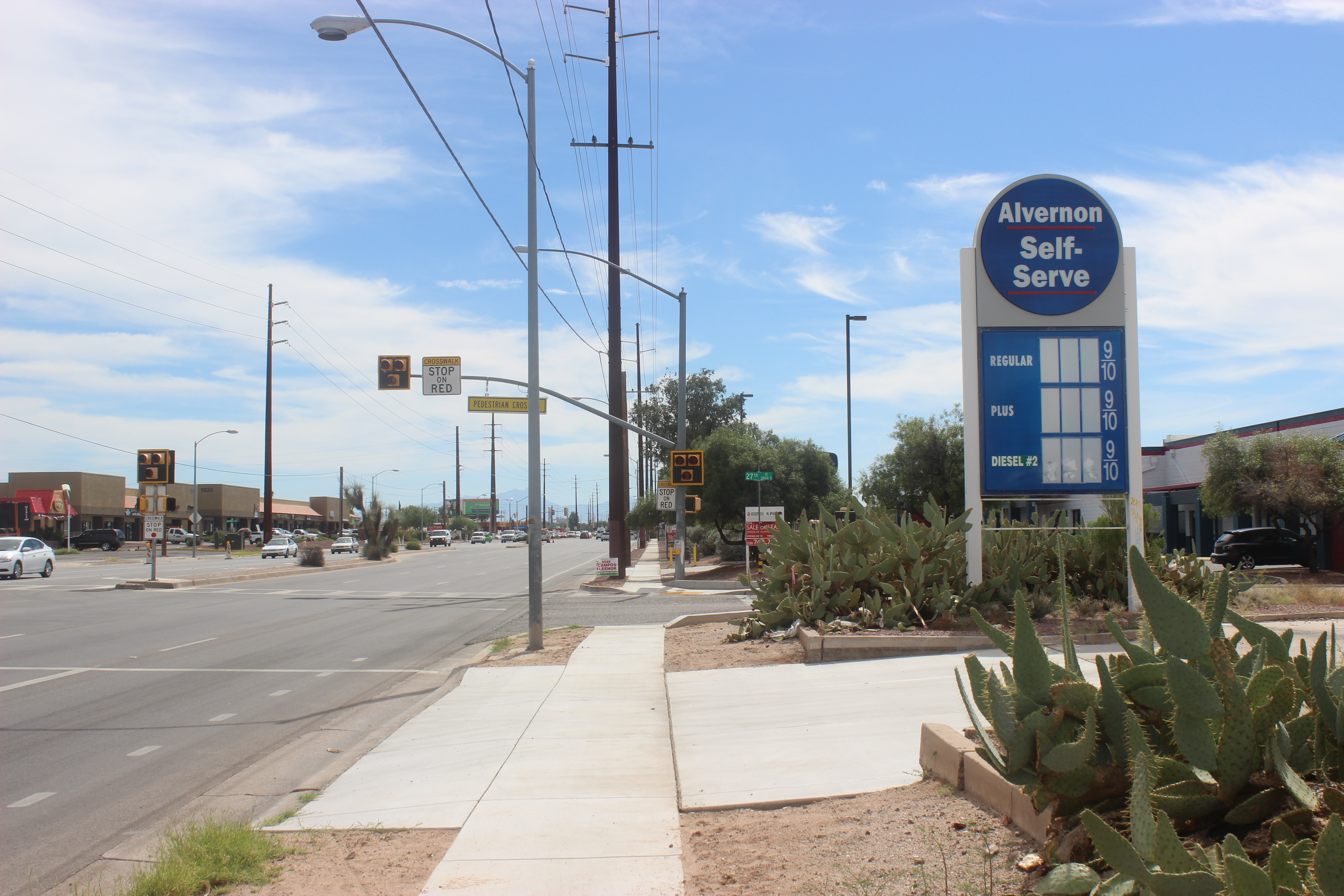
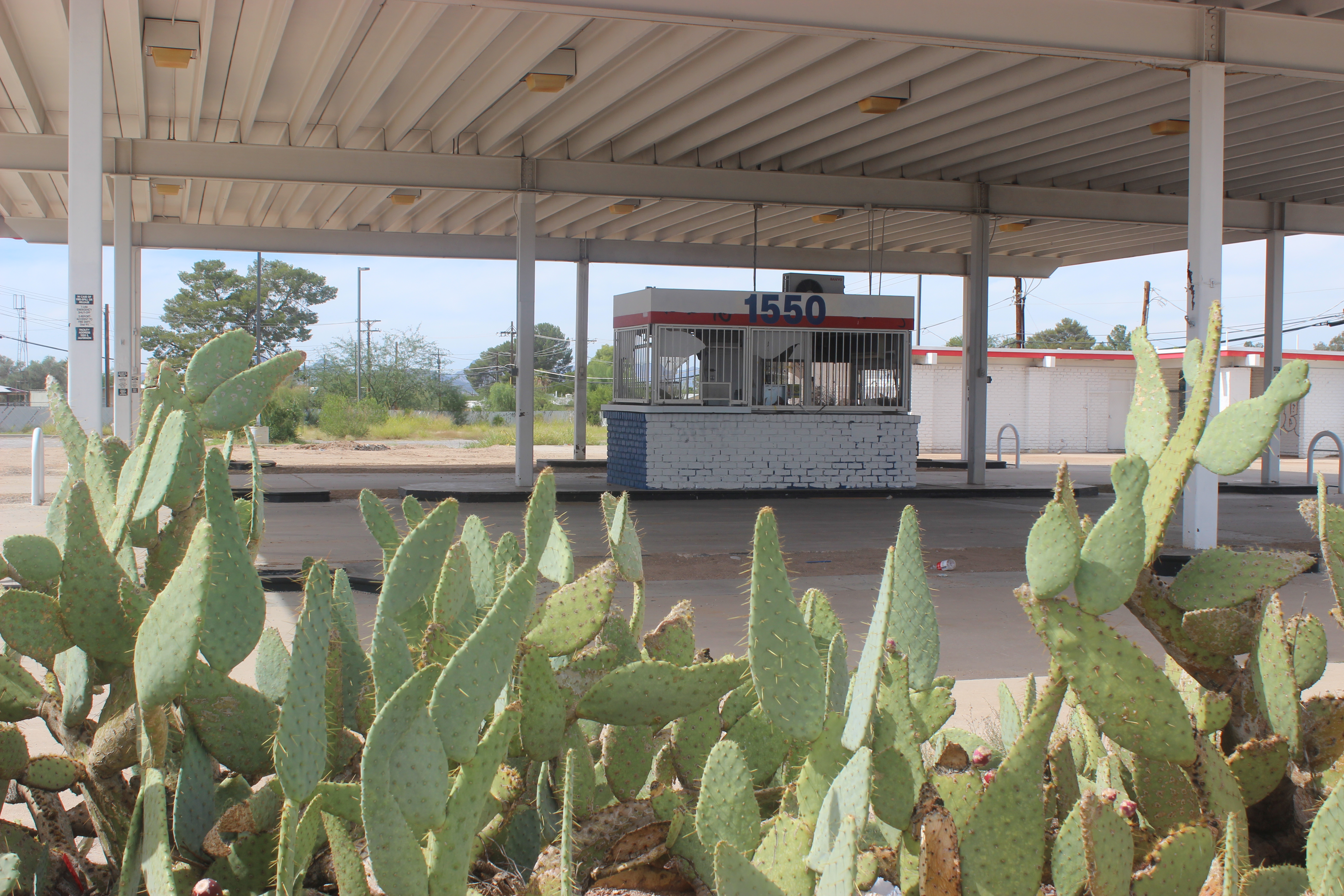
Only a few cacti protect the former Alvernon Self-Serve gas station on the corner of South Alvernon Way and East 27th Street because the chain-link fence was taken down some time ago.

The decaying sign with three fuel grade options out on the street still attempts to beckon potential customers driving down South Alvernon Way, while the former shop nestled between the gas pumps suffers from graffiti covered walls and a shattered window. It’s been like this for about four years. Just a few hundred feet down the road, a steady stream of cars pulls into and out of the modern, standard-type QuikTrip.

IMG_1293

This is a microcosm of what’s happening across Tucson and across the country. Larger service station chains are pushing smaller, independent franchises out of business, said Jerry Bustamante, senior vice president for public policy at the Arizona Small Business Association. Bustamante said the model developed by the larger chains, such as QuikTrip and Costco, is difficult for independent franchises to compete with.

“Their business model is, ‘We’re going to sell you among the cheapest gas town, we’re not going to make a ton of money on the gas, but we’re hoping that you’re going to come inside our convenience store and you’re going to buy coffee, soda, snacks or fresh deli,’” Bustamante said. “That’s where they make their money.”

In Tucson alone, there are 17 QuikTrips and 95 Circle Ks, according to their websites.

Ryan Egan, the realtor for the Alvernon Self-Serve property, said the independent service station couldn’t compete with the rise of the large chains like QuikTrip and Circle K and the owner sold Alvernon Self-Serve and three other gas stations spread across Tucson four years ago to Egan’s realty group.

For Egan, none of the properties have been easy to sell – especially the property on South Alvernon Way.

“Alvernon [Self-Serve] is out-positioned,” Egan said. “There’s a QuikTrip across the street and they’re always going to be able to sell gas for less than an operator at the Alvernon property.”

IMG_1294

The larger chains rely more on profits from sales inside the larger convenience stores they build and much less so on the gas that draws customers in the first place, said Ashley Langer, an assistant professor of economics at the University of Arizona.

These larger, regional chains are pushing independent gas stations out for other reasons as well, she said.

The total number of gas stations across the country is actually declining, Sanger said, in some part to due to rising fuel economy standards, which means drivers don’t have to fill up their gas tanks as often as they used to. This allows consumers to have more of a chance to shop around for lower-priced gasoline.

Sanger said the situation with rising gas station chains in unlike the rise of Walmart, because there are many more competitors among gas station chains. Companies like Circle K and QuikTrip are also just regional brands to the West.

“It’s just the free market reacting to a change in the situation and a change to what people need,” Sanger said.

Bustamante said ASBA advises its members to shop locally to keep more money in the community, but in the end it’s a free market and every customer gets to make their choice.

As more chain link fences rise up around former Tucson gas stations, the issue of what to do with the properties raises another issue.

Egan said he hopes he can sell the Alvernon Self-Serve property to be converted into another use.

Though, this is an expensive and time-consuming process, said Drew Sanderford, an assistant professor of real estate and planning at the UA.

In the course of time a gas station occupies a property, there will almost certainly be a leak from the station’s underground storage tanks, Sanderford said. The Environmental Protection Agency must be able to certify that the ground at the gas station is no longer contaminated for the property to be put in use again, which requires an underground clean-up process.

“This is an expensive proposition for just a regular person who wants to buy this land,” he said.

The EPA does offer some support for redevelopment of land that has been contaminated, such as gas stations.

Egan said it’s more of a psychological issue for potential buyers.

“[Gas stations] are perceived as being higher risk properties – and they are,” he said, “but if you have the proper expertise and contractor to perform the work for you, they can deliver you a property that can be certified as non-contaminated.”

Egan said that even if someone would want the property to be a gas station, the Alvernon location is too small to fit a convenience store to make it competitive against the larger chains.

The price of owning the property for four years now has been difficult, Egan said. It costs $200 to $500 a month to repaint the graffiti that regularly accumulates on the Alvernon Self-Serve property.

Currently no one is interested in buying the Alvernon Self-Serve, but Egan remains optimistic that another buyer will come along soon.

“There was someone interested in the Alvernon property about a month ago,” he said, “but the property wasn’t big for their concept so that fell through.”

Same-sex marriages begin in Arizona

Appeared in the Daily Wildcat on Oct. 17, 2014. Written with Meghan Fernandez, Daily Wildcat news editor.

Same-sex couples in Arizona can now marry following Attorney General Tom Horne’s decision today not to appeal a federal judge’s ruling that Arizona’s same-sex marriage ban is unconstitutional.

Horne said his decision to not appeal the ruling was based on legal considerations and not policy.

“I have decided not to appeal today’s decision, which would be an exercise in futility, and which would serve only the purpose of wasting taxpayers’ money,” Horne said in a statement. “I am issuing a letter today to the 15 county clerks of court with the directive that based on today’s decision by the federal District Court, they can issue licenses for same-sex marriages immediately.”

U.S. District Judge John Sedwick ruled this morning that the decision from the 9th U.S. Circuit Court of Appeals that same-sex marriage bans in Idaho and Nevada were unconstitutional applied to Arizona, invalidating the state’s ban on same-sex marriage

Sedwick said in his ruling that the bans had been ruled unconstitutional because “they deny same-sex couples the equal protection of the law.”

With the decision today, Arizona now becomes the 31st state to allow same-sex marriage in the U.S.

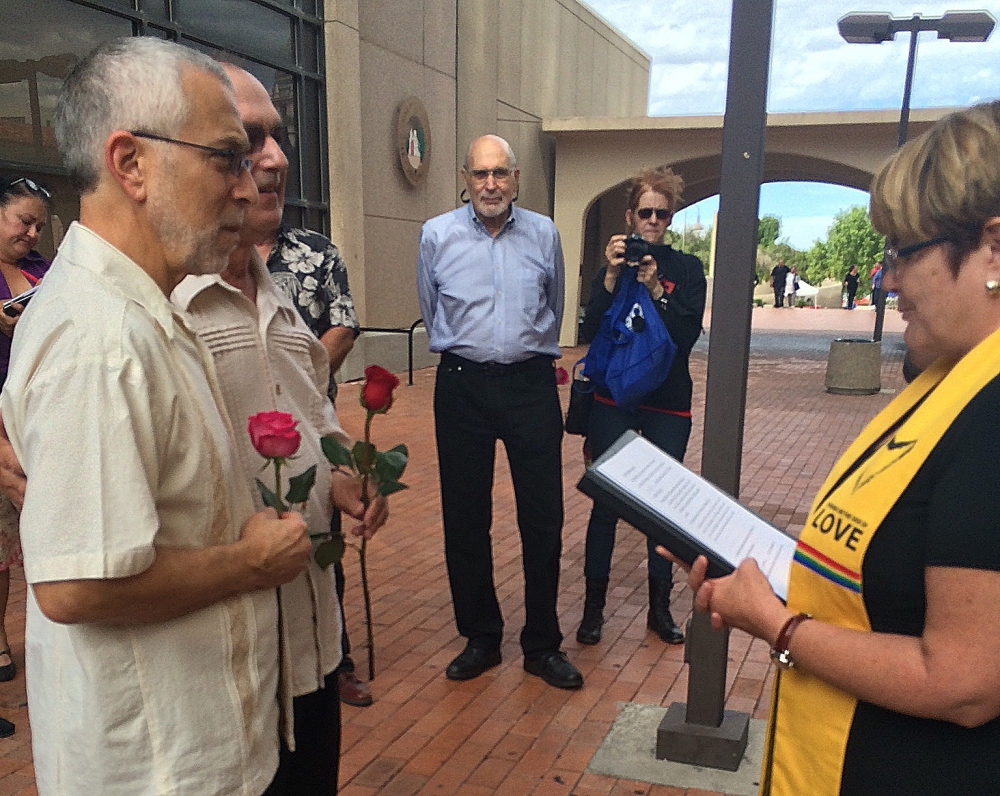
Same-sex couples rushed to the Arizona Superior Court in Pima County in downtown Tucson to sign their marriage licenses. Religious leaders from local churches were waiting outside the courthouse to perform marriage ceremonies.

21512_samesexmeghanfernanf

 The Rev. Owen Chandler, senior minister at Saguaro Christian Church, said even if couples don’t come to the religious leaders for a wedding ceremony, they will still be there in support.

“We’re just happy to be the backdrop of the celebration,” Chandler said.

Chandler said “it just seemed surreal” when he first heard about the decision to strike down Arizona’s ban on same-sex marriage.

“To see it is actually really part of the full momentum of marriage equality,” Chandler said.

Chandler, along with other ministers from different local churches, had been outside the courthouse since they first heard the news about the federal judge’s decision. He also said he was surprised that there weren’t groups of people opposing the decision at the courthouse.

Laura Tenenholtz, a deputy clerk at the Arizona Superior Court in Pima County, briefly took part in the celebration outside the court and said she has been with her partner for more than 11 years.

“It’s about f*cking time,” Tenenholtz said.

Nancy Franklin-Hicks and Davin Franklin-Hicks were one of the first couples to get to the courthouse and receive their marriage licenses. They had a commitment ceremony in 2002 but said they were following the news closely to find out when Arizona would rule the same-sex marriage ban as unconstitutional.

The two had not been able to marry prior to today because while Davin Franklin-Hicks identified as a transgender man, he was still recognized as a woman by the state.

Other Tucsonan same-sex couples included Chuck Gould and Michael Greenbaum. The two have been together for nearly 24 years and said they have been waiting for this day.

“I’m 76,” Greenbaum said. “I never thought I’d see the day.”

Greenbaum said one of the first things he plans to do as a married man is contact his accountant so he and Gould can file joint taxes.

Gould said he has lived in Tucson since 1967 and recalled the gay men he met back then who never thought this day would come and have passed away since.

“I always think about those guys who didn’t get married,” Gould said.

Robert Gordon and Stephen Kraynak had been together for 16 years before saying their vows today outside of the courthouse. Gordon and Kraynak met in Columbus, Ohio, at the Unitarian Universalist Church.

Gordon and Kraynak had a union ceremony at the church in Ohio in 2003, but it wasn’t state-recognized.

“So we’ve been waiting for this day for 10 years,” Gordon said.

Chris Sogge, a graduate assistant for LGBTQ Affairs at the UA, said the beginning of same-sex marriage in Arizona benefits faculty and students at the UA.

“Because as a state we’re recognizing marriage … that will end up bringing more acceptance of [lesbian, gay, bisexual, transgender and questioning] people and will then ripple through into the systems and into their own specific institution,” Sogge said.

Gov. Jan Brewer voiced her disapproval of the decision to strike down the state’s same-sex marriage ban. In a statement, she said the courts have “thwarted the will of the people.”

“It is not only disappointing, but also deeply troubling that unelected federal judges can dictate the law of individual states,” Brewer said.

Earlier this year, Brewer vetoed a religious freedom bill known as SB 1062 that critics derided as discriminatory against LGBTQ people.

The decision also comes on the last day of Coming Out Week at the UA, which brings visibility to resources available to the LGBTQ community at the university.

— Joey Fisher contributed reporting to this article.

View on dailywildcat.com here